
Monetary Authority Of Singapore Monetary Policy Statement - January 2026
INTRODUCTION
1. In its October 2025 monetary policy review, MAS maintained the rate of appreciation of the Singapore dollar nominal effective exchange rate (S$NEER) policy band, with no change to the width of the band or the level at which it was centred. Since then, the S$NEER has strengthened in the upper half of the appreciating policy band.
Chart 1
S$ Nominal Effective Exchange Rate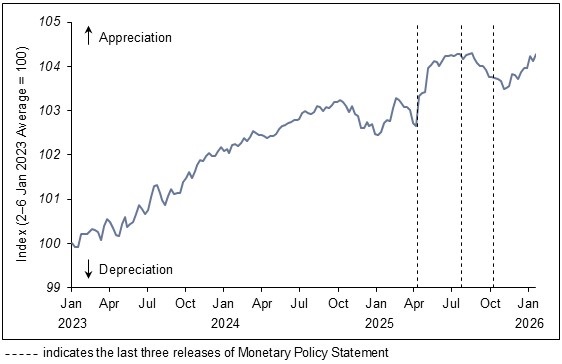
GROWTH BACKDROP
2. Economic activity in Singapore’s major trading partners remained resilient in the last quarter of 2025, buoyed by the AI-related investment boom and reduction in trade policy uncertainty. This year, global growth is expected to ease modestly, as the lagged effects of higher tariffs weigh on final demand and trade. Nevertheless, the extent of the global economic moderation could be mitigated by supportive fiscal and monetary policies. In the near term, the global AI capex upcycle should also continue apace, and provide strong support for economies plugged into the electronics supply chain.
3. In line with the global economic backdrop, advance estimates from MTI show that the Singapore economy grew by 1.9% on a quarter-on-quarter seasonally-adjusted basis in Q4 2025, following the 2.4% expansion in the preceding quarter. Growth came in stronger than projected, largely due to robust performance of the manufacturing and services segments that are closely tied to the global technology cycle.
4. In the near term, Singapore’s GDP growth should be resilient, although uncertainties to the outlook remain. The expansion in the trade-related sectors is likely to be underpinned by continuing near-term strength in the global AI-driven capex cycle. Growth in non-technology-related segments is also forecast to be firm: financial services should be supported by steady lending and capital market activity, while the construction sector will benefit from a continuing pipeline of public and private projects. For the full year, GDP growth is expected to ease relative to the stronger outturn in 2025, with the positive output gap projected to narrow over the course of the year.
INFLATION OUTLOOK
5. MAS Core Inflation
6. Core inflation is expected to increase modestly in the near term. This will reflect a pick-up in services unit labour costs growth from its subdued pace earlier in 2025. At the same time, the recent rise in services productivity could be sustained, dampening the extent of cost increases. Meanwhile, imported inflation should remain contained. Global oil and food commodity prices are projected to decline this year, albeit at a progressively slower pace over the quarters. Regional consumer price inflation is forecast to only edge up, as subdued producer prices in Asia continue to dampen cost pressures.
7. The forecasts for MAS Core Inflation and CPI-All Items inflation for 2026 have both been raised to 1.0–2.0%, from 0.5–1.5% in the October 2025 Monetary Policy Statement. On average over 2026, core inflation momentum is expected to come in at a pace that is slightly below trend. CPI-All Items inflation would additionally reflect subdued accommodation costs with the continued passthrough of weaker housing rental growth of the past year.
8. The risks to the growth and inflation outlook are tilted to the upside at this point. Persistently stronger-than-expected GDP growth could lead to higher wage growth and boost consumer sentiment, exacerbating demand-pull inflationary pressures. Supply shocks, including those triggered by geopolitical developments, risk lifting imported costs. Nevertheless, some downside risks are also present, reflecting underlying fragilities in the global economy. For instance, a sharp correction in global financial markets or an abrupt pullback in global AI-related investment would induce a faster pace of easing in growth and consequently lower inflation.
MONETARY POLICY
9. MAS had kept the S$NEER policy band on an appreciating slope in July and October last year. Following the strong performance in 2025, growth this year is expected to remain resilient and the output gap positive for the year as a whole. After a period of weakness, underlying price pressures are returning closer to trend. MAS Core Inflation is projected to normalise in 2026 and average 1.0–2.0%.
10. MAS will therefore maintain the prevailing rate of appreciation of the S$NEER policy band. There will be no change to its width and the level at which it is centred. MAS is in an appropriate position to respond effectively to any risk to medium-term price stability and will continue to closely monitor economic developments amid uncertainties in the external environment.
***
[1] MAS Core Inflation excludes the costs of accommodation and private transport from CPI-All Items inflation.
Related: